
Every autumn near Churchill, Manitoba—the self-proclaimed polar bear capital of the world—hundreds of polar bears gather along the shores of Hudson Bay…waiting. They are waiting for the sea ice to return, for the platform that is essential for them to hunt seals, to survive. But each year, they wait longer. And with each passing year, fewer bears make that journey.
I just returned from Hudson Bay to observe polar bears with Polar Bears International and the climate changes impacting them. I was stunned by how warm it was in late October; that there was no snow on the ground; that the local residents – the bears, the Arctic hare, the ptarmigan, and snowy owls were white – their millennium-old camouflage now making them highly visible and vulnerable.
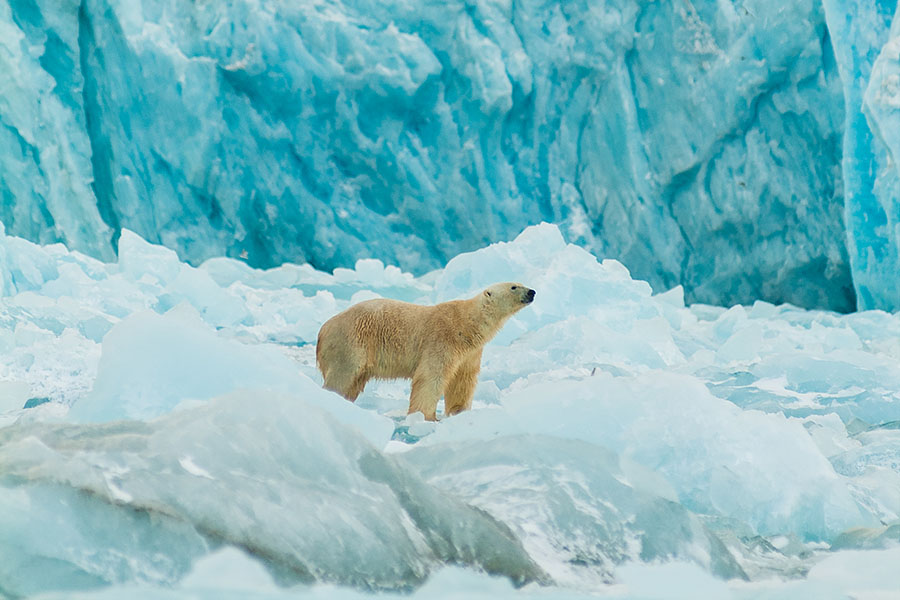
One young female bear, whose picture accompanies this article, came so close to our tundra buggy that I could look into her eyes – and she did not turn away but stared at me as I stared at her. She was curious and very hungry, a beautiful masterpiece of evolution. She looked fine 15 days ago. What about at 165 days without food? She must have the strength to hunt. The realization of extinction, looking straight into my eyes, I will never forget. She spoke to the very roots of my humanity; shot an arrow straight into my heart as my part in sentencing her and her species to probable extinction settled over me.


The Western Hudson Bay polar bear population has declined by roughly 50% since the 1980s.1 In just five years between 2016 and 2021, the population plummeted by 27%, dropping from approximately 800 bears to just 618.2 These are not abstract statistics—they represent mothers who cannot feed their cubs, young bears who starve before reaching adulthood, and an entire population sliding toward local extinction.
UNDERSTANDING THE POLAR BEAR
Understanding the polar bear’s life cycle reveals why sea ice loss is so devastating. Between April and late June, male polar bears search for mates on sea ice, and after mating, fertilized eggs undergo delayed implantation—only developing if the female has accumulated enough fat to sustain herself and her cubs through the long denning period.3 It is important to note that polar bears survive mostly on a fat diet and rarely eat a lot of meat, as their kidneys are not built for meat metabolism.
In autumn, pregnant females dig maternity dens in snowdrifts and give birth to cubs weighing barely one pound in December or January, nursing them on milk that is 31% fat until the family emerges in March or April.4 This extraordinary maternal investment—going up to eight months without eating while producing the richest milk of any land mammal—depends entirely on the mother having hunted successfully during the spring ice season.But that critical seal-hunting season is vanishing. The ice-free period in Hudson Bay is now four to six weeks longer than in the early 1980s, meaning bears spend an additional month or more without access to food.5 Bears lose approximately one kilogram (2.2 pounds) of body weight for every day they fast, and recent monitoring found 19 out of 20 bears lost 47 pounds in just three weeks—about 7% of their body weight.6 For pregnant females already facing an eight-month gap between meals, this extended starvation period often means they cannot accumulate the 200 kilograms necessary for successful pregnancy and cub-rearing.7


THE MATHEMATICS OF SURVIVAL ARE BRUTALLY SIMPLE
Research has identified approximately 180 days as a critical fasting threshold—the limit at which up to 21% of adult males and 63% of subadults could starve to death.8 Recent projections indicate that limiting global warming to 2°C above pre-industrial levels may prevent the ice-free period from exceeding 183 days in both Western and Southern Hudson Bay, but with longer ice-free periods already substantially impacting recruitment, extirpation may already be inevitable.9
We know exactly what is happening. We know why. Hudson Bay has warmed over 1°C in the last 30 years, with spring sea ice melting earlier and fall freeze-up occurring later, leading to a month or longer of ice-free conditions.9 A 2024 study examining sea ice levels, the 180-day hunger threshold, and climate simulations found that once Earth warms another 1.3 to 1.4 degrees Celsius from now, polar bears will likely cross the point of no return.10 The culprit is not mysterious: it is the 154 million pounds of carbon dioxide we collectively emit into the atmosphere every minute, the direct result of our continued dependence on fossil fuels.
Here is where our complicity becomes undeniable. For decades, we have known the consequences of burning coal, oil, and gas. Yet the fossil fuel industry—with full knowledge of the devastation ahead—has spent billions funding climate denial, lobbying against clean energy policies, and deliberately delaying the transition we desperately need. We have allowed them to hold us hostage, prioritizing short-term profits over the survival of species that took millions of years to evolve, not to mention next generations.
When we lose the Hudson Bay polar bears, we lose more than a charismatic megafauna. We lose a top predator whose role in the Arctic ecosystem extends far beyond their own survival. We lose the accumulated wisdom of mothers teaching cubs to hunt seals, of bears that can smell prey through three feet of ice of animals so perfectly adapted to their environment that their transparent fur and black skin create a natural solar heating system. We lose living proof that life can thrive in Earth’s harshest places—and we lose it not to natural selection or an evolutionary process, but to deliberate and well-known human choice.

YET—AND THIS IS CRUCIAL – WE STILL HAVE TIME
Limiting global warming to 2 degrees Celsius, and ideally 1.2-1.5 °C above pre-industrial levels, could help many polar bear populations survive, and we already have the solutions we need to transition away from fossil fuels.11 The technology exists: renewable energy is now cheaper than fossil fuels in most markets. The science is clear. What we lack is not capability but collective will. It is a matter of values.
As scientist Katharine Hayhoe says, we need “all options on the table and all hands on deck”.12 That means aggressive emissions reductions, protecting critical polar bear habitats, supporting Indigenous communities who have coexisted with bears for millennia, and holding fossil fuel companies accountable in courts and on the ground and in the oceans for the damage they have knowingly caused. It means recognizing that the polar bear’s future and our own are inseparable—we too depend on sea ice to stabilize weather, the climate, and a healthy planet.

STILL WAITING – AND HOPE IN ACTION
While I am writing this, the polar bears are still waiting on the shores of Hudson Bay. They are still having cubs, still teaching them to hunt, still demonstrating the resilience that allowed their species to survive for hundreds of thousands of years. We owe them—and ourselves—the courage to break free from fossil fuel dependence before that wait becomes eternal. The choice, ultimately, is ours. We can be the generation that lets polar bears slip into extinction, or we can be the generation that finally acts with the urgency this crisis demands.
At the UN Conference on Climate Change, COP30, convening in Belem, Brazil, in November 2025, the President of Brazil, Lula de Silva, has announced he will take to the 2026 G-20 in Miami, FLA, USA, next December, a strong proposal and recommendation to phase out fossil fuels. This is an incredibly hopeful sign not just for polar bears, but for all Arctic dwellers and the rest of us as well.
The ice is melting, but it is not yet gone. We still have time. The question is whether we will use it with the urgency required and the wisdom.
References
1. York, G., Stroeve, J., et al. “Western Hudson Bay Polar Bears.” Polar Bears International, 2024. https://polarbearsinternational.org/what-we-do/research/western-hudson-bay-polar-bears/
2. Atkinson, S., et al. “Steep Decline in Western Hudson Bay Polar Bear Population.” Government of Nunavut Report, 2021. https://polarbearsinternational.org/news-media/articles/steep-decline-in-western-hudson-bay-polar-bears/
3. “Life Cycle.” Polar Bears International, 2024. https://polarbearsinternational.org/polar-bears-changing-arctic/polar-bear-facts/life-cycle/
4. “Top Mom and Cub Facts.” Polar Bears International, 2024. https://polarbearsinternational.org/news-media/articles/polar-bear-mom-cub-facts/
5. York, G., Stroeve, J. “Western Hudson Bay Polar Bears.” Polar Bears International, 2024.
6. Borenstein, S. “Churchill, Manitoba where ice and polar bears are in trouble.” Associated Press, March 14, 2025. https://www.aptnnews.ca/national-news/churchill-manitoba-ice-polar-bears-trouble-climate-crisis/
7. “All About Polar Bears – Birth & Care of Young.” SeaWorld Parks & Entertainment, 2024. https://seaworld.org/animals/all-about/polar-bears/care-of-young/
8. “Western Hudson Bay Polar Bears.” Polar Bears International, 2024.
9. Stroeve, J., York, G., et al. “Ice-free period too long for Southern and Western Hudson Bay polar bear populations if global warming exceeds 1.6 to 2.6 °C.” Communications Earth & Environment, June 13, 2024. https://www.nature.com/articles/s43247-024-01430-7
10. Borenstein, S. “Research reveals threats polar bears face as climate change melts Arctic ice hunting grounds.” PBS News, September 24, 2024.
11. “Hudson Bay polar bears may not survive climate change.” The Wildlife Society, July 2, 2024. https://wildlife.org/hudson-bay-polar-bears-may-not-survive-climate-change/
12. “Climate Change Solutions to Save Polar Bears and Melting Sea Ice.” Polar Bears International, 2024. https://polarbearsinternational.org/news-media/articles/climate-change-solutions-polar-bears/